STEN Mark 5

The STEN Mk 5: From Austerity to Refinement |
|
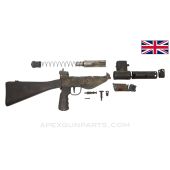
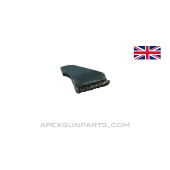
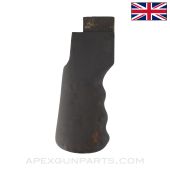
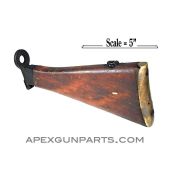
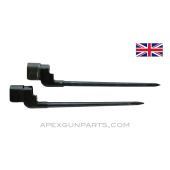
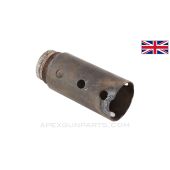
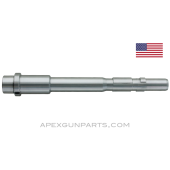
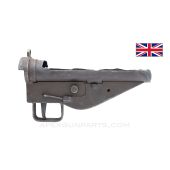
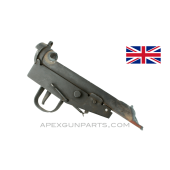
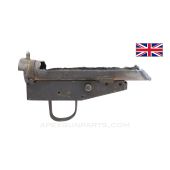
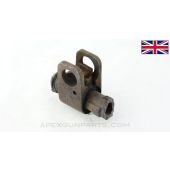
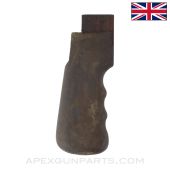
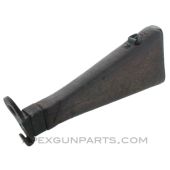
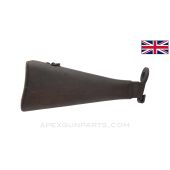
The STEN Mk 5 represented a significant shift from the "economy" mindset of the early 1940s toward a more professional military standard. Designed by Major Reginald V. Shepherd and Harold J. Turpin at the Royal Small Arms Factory (RSAF), Enfield, the STEN series was originally a response to the massive loss of equipment at Dunkirk. While earlier versions were famously crude, the Mk 5 was introduced in 1944 to provide paratroopers and infantry with a more substantial weapon. It was primarily manufactured at RSAF Enfield and Theale, featuring a wooden fixed stock, a wooden pistol grip, and a brass buttplate. These additions made the weapon heavier, bringing its weight to approximately 3.9 kg (8.6 lbs), a notable increase over the 3.2 kg of the Mk 2. Technically, the Mk 5 remained a blowback-operated submachine gun chambered in 9x19mm Parabellum, but it introduced several high quality specifications. It featured a 7.8 in barrel with a redesigned muzzle that utilized two lugs to accommodate the standard bayonet, the same used on the Lee Enfield No. 4 rifle. The sights were also improved to match the No. 4 rifle's sighting plane, allowing for better accuracy at its effective range of roughly 100 meters. Despite these upgrades, it still utilized the notorious 32 round double column, single feed box magazine, which remained the primary source of the weapon’s occasional feeding failures and jams during its cyclic rate of 500 to 600 rounds per minute. The Mk 5 saw its most intense combat during the airborne operations of late 1944, most notably in the hands of the 1st Airborne Division during the Battle of Arnhem. Following the war, it remained the standard issue submachine gun for the British Army during the Korean War and the Mau Mau Uprising. However, the military ultimately decided that the STEN’s basic design had reached its limit. In 1953, the British government officially adopted the L2A1 Sterling submachine gun, designed by George Patchett. The Sterling utilized a superior curved magazine and a more reliable bolt design, leading to the STEN Mk 5 being declared obsolete by the mid-1950s but still saw service afterward. |